HOW LIFE INSURANCE CAN HELP YOU MAKE A BIGGER CHARITABLE IMPACT
Turning Today's Generosity Into Tomorrow's Lasting Legacy
For many individuals and families, charitable giving is an important part of their financial and estate planning. Whether it is supporting a cause close to their hearts, giving back to their community, or establishing a lasting family legacy, philanthropy offers an opportunity to make a meaningful difference.
Depending on the donor’s circumstances and objectives, life insurance may provide another way to structure a future charitable gift.
One strategy that is often overlooked is the use of life insurance to leverage charitable giving. When properly structured, life insurance can help individuals turn a series of manageable financial contributions into a potentially much larger future gift to the organizations they care about.
The Power of Charitable Leverage
Most people think of charitable giving in fairly straightforward terms. If you donate $10,000 to your favorite nonprofit, the organization receives $10,000 to support its mission.
And while direct donations are incredibly valuable, particularly for organizations that rely on annual fundraising to support their operations, there may be another opportunity worth considering.
Rather than making all charitable contributions directly, an individual could allocate a portion of their charitable budget toward premiums on a permanent life insurance policy.
The policy may provide, if kept in force, a death benefit to the designated charitable organization, potentially creating a gift substantially larger than the cumulative premiums paid.
This approach is sometimes referred to as charitable leverage because the policy’s death benefit may exceed the cumulative premiums paid. The result is not guaranteed unless the policy’s applicable guarantees are satisfied, required premiums are paid, and the policy remains in force until the insured’s death.
What Could This Look Like?
Consider a hypothetical example. Imagine a 60-year-old individual who is passionate about supporting a particular charitable organization and has the financial ability to commit $25,000 annually over the next 10 years.
Through traditional charitable giving, for illustrative purposes only, suppose that individual would contribute a total of $250,000 directly to the organization. Alternatively, the individual qualifies for a permanent life insurance policy that provides a $750,000 death benefit, based on an assumed initial premium-funding schedule of $25,000 annually for 10 years.
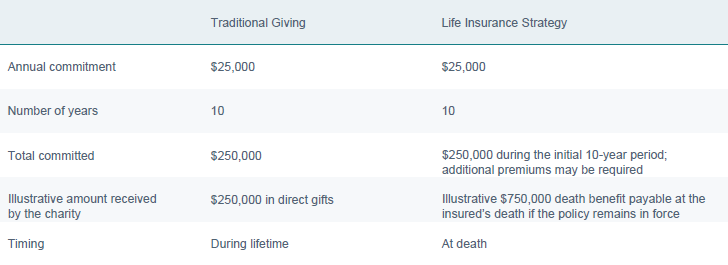
In this hypothetical scenario, the donor commits the same $250,000 but potentially creates a $750,000 charitable legacy. In this hypothetical example, the illustrated death benefit is greater than the cumulative premiums paid. However, the comparison does not account for the timing or potential investment growth of direct charitable contributions, policy charges, the insured’s life expectancy, possible additional premiums, or the value of the charity’s immediate use of direct gifts.
Of course, these numbers are purely illustrative. Actual death benefits and premium requirements depend on factors such as age, health, underwriting, and policy design. The policy must remain in force for the death benefit to be paid, and premiums may need to continue beyond the initial funding period. Traditional donations may also be invested and grow over time.
The broader concept may be appropriate for certain donors: life insurance may provide a way to make a larger future charitable commitment without requiring the donor to contribute the entire death benefit amount.
Three Ways to Incorporate Life Insurance Into Charitable Planning
There is not just one way to structure this strategy. Depending on an individual's financial situation, charitable intentions, and estate planning objectives, several approaches may be worth exploring.
1. Having the Charity Own the Life Insurance Policy
Under this arrangement, the charitable organization owns the life insurance policy and is named as its beneficiary. The donor makes contributions to the organization, which uses those funds to pay the insurance premiums. When the insured individual passes away, the charity receives the death benefit.
One potential advantage is that contributions to a qualifying charitable organization may be eligible for an income tax deduction, subject to applicable IRS rules and limitations. However, the donor generally gives up ownership and control of the funds contributed, and the charity must be willing to accept and maintain the policy.
2. Naming a Charity as the Beneficiary of Your Own Policy
Another option is for the individual to personally own a life insurance policy and name one or more charitable organizations as beneficiaries. This approach provides greater flexibility.
For example, an individual could designate 50% of the death benefit to one charity, 25% to another, and the remaining 25% to a third organization. If charitable priorities change over time, the donor can generally adjust those beneficiary designations.
While premiums paid on a personally owned policy generally do not qualify for a charitable income tax deduction, this approach can provide a straightforward way to incorporate philanthropy into an estate plan.
3. Combining Charitable Giving With Family Wealth Preservation
For individuals who want to make substantial charitable gifts but are also concerned about preserving wealth for their children or grandchildren, life insurance can play another important role.
Consider someone who intends to leave $1 million from their estate to a charitable organization. While this is a wonderful philanthropic commitment, it also means $1 million less may be available to pass on to family members.
One potential strategy is to use life insurance to replace some or all of the wealth directed toward charity. The individual could establish a charitable bequest while maintaining a separate life insurance policy intended to provide a death benefit to their heirs.
When properly structured, this strategy may allow someone to create a meaningful charitable legacy and preserve an inheritance for future generations. Depending on the estate circumstances, the tax and estate consequences will depend on factors such as policy ownership, beneficiary designations, incidents of ownership, the donor’s estate, and applicable federal and state law. This approach requires careful coordination with estate planning attorneys and tax professionals.
Creating a Legacy That Lasts for Generations
One of the most interesting applications of charitable life insurance planning involves establishing or expanding an endowment. Many nonprofit organizations maintain endowment funds designed to support their missions over the long term.
Imagine a donor who wants to support an organization that has played a meaningful role in their family life. Rather than simply leaving an unspecified amount from their remaining estate, the donor could establish a life insurance policy intended to provide a substantial future gift.
Subject to the charitable organization’s gift-acceptance policies and governing documents, the organization may agree to use the proceeds to establish or support an endowment. Naming rights and restrictions must be agreed upon separately with the organization. If invested and managed appropriately, that endowment could help fund programs, services, education, research, or other charitable initiatives for years to come.
The result is something much bigger than a financial transaction. It is an opportunity to create a lasting connection between a family values and the causes they believe in.
Is Life Insurance a Better Way to Give?
Not necessarily. And that is an important distinction.
Charitable organizations need financial support today, not just in the future. Direct contributions allow nonprofits to pay employees, provide services, fund research, and support their communities immediately. A life insurance death benefit, on the other hand, is generally paid at an unknown future date.
For that reason, we often view life insurance-funded charitable giving as a potential complement to traditional philanthropy rather than a replacement for it. A thoughtful strategy might involve continuing annual donations while dedicating a portion of a charitable budget toward creating a larger future legacy.
The appropriate balance depends on the donor goals, financial resources, insurance needs, and the organization priorities.
Who Might Benefit From This Strategy?
• Have a strong personal connection to a charitable organization or cause.
• Regularly make charitable contributions and want to expand their long-term impact.
• Have predictable income or assets available to support ongoing insurance premiums.
• Want to establish a charitable endowment or family legacy.
• Are interested in incorporating philanthropy into their estate planning.
• Want to balance charitable giving with wealth preservation for children and grandchildren.
As with any financial strategy, the details matter. Insurance costs, insurability, policy ownership, tax treatment, and long-term funding requirements all need to be considered.
Generational Wealth Is Not Just About What You Leave Your Family
When we talk about generational wealth, the conversation often focuses on financial assets: investments, retirement accounts, real estate, businesses, and life insurance. But building a legacy involves more than transferring money. It is also about passing along values.
For some families, that means creating financial security for children and grandchildren. For others, it means supporting organizations that have made a difference in their lives or helping future generations access opportunities they might not otherwise have. And for many, it is a combination of both.
Life insurance can provide a unique planning opportunity by potentially allowing individuals to leverage the resources they already intend to dedicate to charitable giving.
The question is not simply how much you can afford to give. It is how much of a difference you can ultimately make.
Let Us Explore Your Legacy Planning Opportunities
At Creative Wealth Solutions, we believe that thoughtful financial planning should consider not only how you accumulate and preserve wealth, but also how you ultimately put that wealth to work.
Whether your priority is supporting your family, giving back to your community, or creating a lasting charitable legacy, there may be opportunities to accomplish more through coordinated financial, estate, and charitable planning.
If charitable giving is important to you, we can help you evaluate the features, costs, limitations, and funding requirements of life insurance that may be considered as part of your charitable-giving goals. Please consult your independent legal and tax professionals before implementing a charitable-planning strategy.
Important Disclosures
This article is intended for general educational purposes and should not be considered individualized financial, legal, or tax advice. The hypothetical life insurance example does not represent an actual policy illustration or guarantee. Actual policy premiums and death benefits depend on age, health, underwriting, policy design, and other factors. Life insurance policies may contain fees, expenses, limitations, and nonguaranteed elements. Maintaining coverage may require premiums beyond the illustrated contribution period. Policy guarantees are subject to the claims-paying ability of the issuing insurance company. Charitable tax deductions and estate tax treatment depend on individual circumstances, policy ownership, the recipient organization qualifications, and applicable tax laws. Consult qualified legal and tax professionals before implementing any charitable giving or estate planning strategy.